Shape of the challenger dataset
For people familiar with Python, xarray and dask, the fastest way to get an idea of the required challenger datacube is to look at this notebook.
In addition, you can open and explore the official challenger datasets by using the oceanbench.datasets.challenger module, the documentation is here.
The following figure provides an illustration of the shape of a challenger dataset at 1/12° resolution.
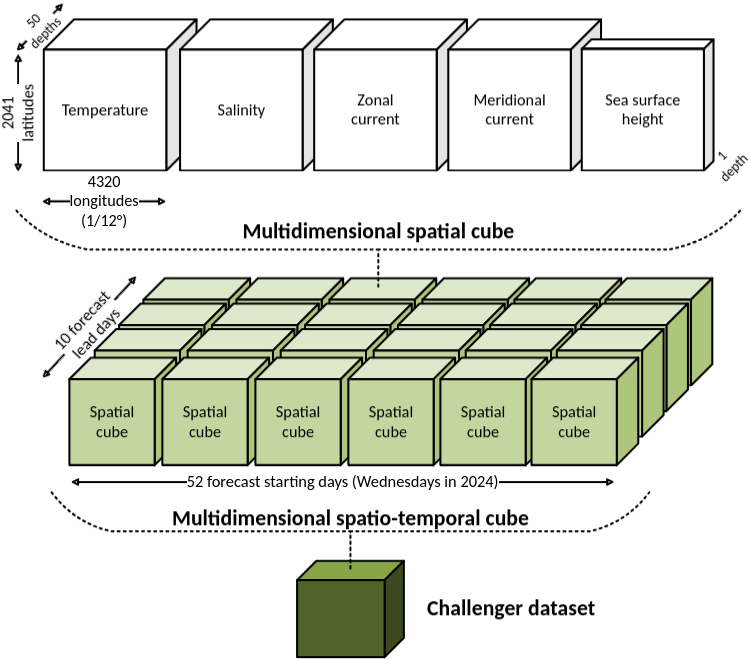
The challenger dataset must contain all 10-day forecasts starting on the 52 Wednesdays of the year 2024.
Hence, it must be a datacube with at least 5 dimensions and 5 variables as defined in the Climate and Forecast Convention (CF).
Dimensions:
Latitude (standard grid)
Longitude (standard grid)
Depth (positive depth level in the ocean)
Lead day index (from 0 to 9, corresponding to the 10 days of forecasts)
First day datetime (datetime of the first day of forecast)
Variables:
Sea surface height above geoid (over all dimensions except depth)
Sea water potential temperature (over all dimensions)
Sea water salinity (over all dimensions)
Northward sea water velocity (over all dimensions, also named meridional current)
Eastward sea water velocity (over all dimensions, also named zonal current)
The challenger dataset dimensions and variables must be named according to the Climate and Forecast Convention (CF) standard names or have a standard_name attribute containing the corresponding CF standard name.
The challenger dataset should be opened as an xarray.Dataset, with explicit dask chunks for best performances.
Finally, OceanBench supports challenger datasets with 1/12° resolution or 1/4° resolution.